
Once you’ve determined that a project needs NEPA, the next question is: what kind of environmental review does it need?
There are three levels: a Categorical Exclusion (CE), an Environmental Assessment (EA), and an Environmental Impact Statement (EIS). The level required depends on how much impact the project is expected to have on the environment.
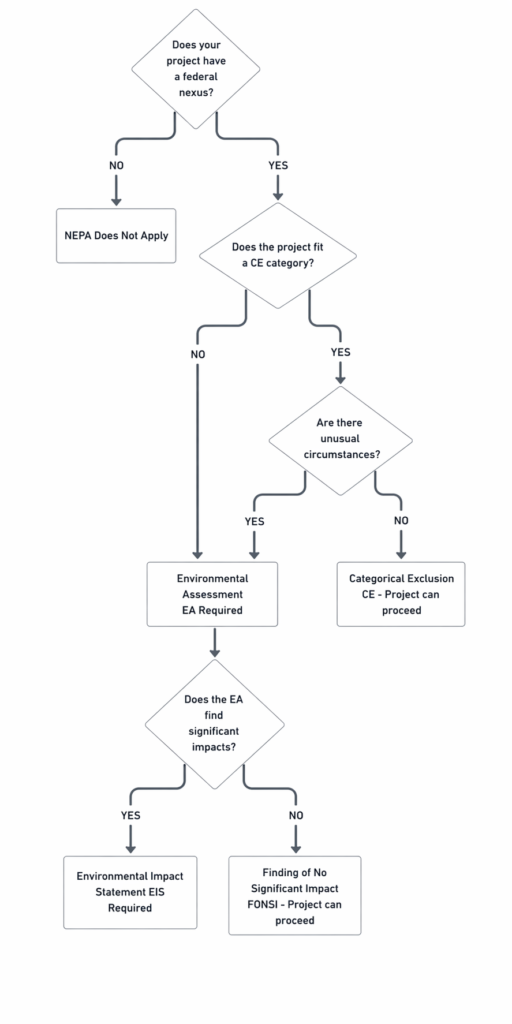
Here’s how each one works.
Categorical Exclusion (CE)
A categorical exclusion is the simplest and most common level of NEPA review. It applies to projects that don’t individually or cumulatively have a significant effect on the environment.
Categorical exclusion projects are ones that have been done many times before and are well understood. Federal agencies maintain lists of project types that qualify as CEs. If your project fits one of those categories and no unusual circumstances apply, you can move forward with a CE instead of a full environmental study.
Common examples of categorical exclusion projects:
- Resurfacing or rehabilitating an existing road
- Adding a turn lane or bike lane to an existing street
- Installing traffic signals or signs
- Replacing a bridge on the same alignment
- Minor pedestrian and safety improvements
A CE doesn’t mean there’s no environmental review. It means the review is streamlined because the type of project is already well understood. Documentation is still required, but it’s much lighter than an EA or EIS.
How long it takes: Weeks to a few months, depending on the agency and project complexity.
Environmental Assessment (EA)
An EA is the middle tier. It applies when a project doesn’t clearly qualify for a categorical exclusion but also isn’t expected to have significant environmental impacts.
The EA is essentially a study to figure out whether the project will cause significant impacts. At the end of the EA process, one of two things happens:
- Finding of No Significant Impact (FONSI): The agency concludes the project won’t cause significant impacts. The project can move forward without an EIS.
- The project gets elevated to an EIS: If the EA finds that significant impacts are likely, a full Environmental Impact Statement is required.
Most EAs result in a FONSI. An EA that leads to an EIS is less common but does happen.
Common examples of EA projects:
- A new road or highway on a new alignment
- A project that affects wetlands, floodplains, or sensitive habitat
- A project in or near a historic district
- A larger bridge replacement with changes to the footprint
- Projects with significant community or land use impacts
How long it takes: Typically 6 months to 2 years depending on complexity and how many resource agencies are involved.
Environmental Impact Statement (EIS)
An EIS is the most rigorous level of NEPA review. It’s required when a project is expected to have significant effects on the human environment.
An EIS involves a full analysis of the project’s impacts, alternatives, and mitigation measures. It includes a public scoping process, a draft EIS published for public comment, responses to those comments, and a final EIS. At the end, the agency issues a Record of Decision (ROD) documenting what was decided and why.
EIS projects are major undertakings. They’re relatively rare in local agency work but common for large infrastructure projects.
Examples of EIS projects:
- A new freeway or major highway expansion
- A large transit project like a light rail line
- A project with unavoidable significant impacts to natural resources
- Any project that triggered an EA and was found to have significant impacts
How long it takes: Typically 2 to 5 years, sometimes longer for complex projects.
Side by Side
| CE | EA | EIS | |
|---|---|---|---|
| When it applies | No significant impact, fits a listed category | Uncertain significance, needs study | Significant impacts expected |
| Documentation | Short form, streamlined | Environmental Assessment report | Full EIS document with alternatives |
| Public involvement | Minimal to none | Sometimes required | Required (scoping + comment periods) |
| Outcome | Project approved | FONSI or elevated to EIS | Record of Decision |
| Typical timeline | Weeks to months | 6 months to 2 years | 2 to 5+ years |
How to Know Which One You Need
Most local agency projects qualify for a categorical exclusion. Most federal agencies publish lists of project types that qualify as CEs. In Caltrans Local Assistance work, these are found in 23 CFR 771.117. If your project fits one of those categories and no unusual circumstances apply, you have your answer.
If your project doesn’t fit a CE category, or if there are unusual circumstances that raise questions about potential impacts, an EA is the next step.
An EIS is typically reached one of two ways: the project is clearly a major action with significant impacts from the start, or an EA study concludes that impacts are significant enough to require one.
When in doubt, talk to your DLAE early. Getting the level of review right at the beginning saves time and avoids having to redo work later.
The Bottom Line
CE, EA, and EIS are not arbitrary bureaucratic categories. They reflect how much we actually know about a project’s impacts and how much study is needed before it can move forward. Most local agency projects qualify for a categorical exclusion. EAs are for projects where that’s not clear. EIS is for the big ones.
Knowing which level applies to your project is the foundation of the entire NEPA process.