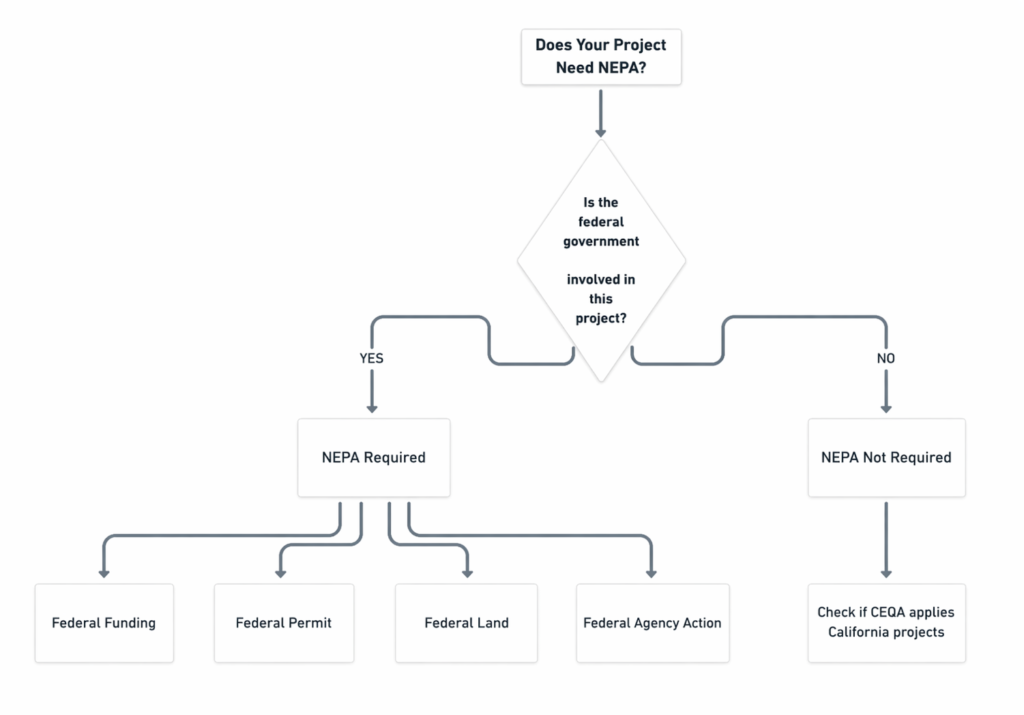
If you’ve ever wondered whether your project needs to go through NEPA, the first question to answer is simple: is the federal government involved?
That involvement is called a federal nexus. No federal nexus, no NEPA.
Here’s what that means in practice.
What Is a Federal Nexus?
NEPA (the National Environmental Policy Act) applies to federal actions. It doesn’t apply to every project, and it doesn’t apply just because a project affects the environment.
A federal nexus exists when any one of these is true:
| Trigger | What It Means | Example |
|---|---|---|
| Federal Funding | Any federal dollars used, even partial | City road project using STIP or CMAQ funds |
| Federal Permit | A federal approval is required to proceed | Section 404 permit from Army Corps for wetland impacts |
| Federal Land | Project is on or crosses federal land | Trail project crossing National Forest land |
| Federal Agency Action | A federal agency is doing the project | FHWA approving a new highway alignment |
If any of those are true, NEPA applies and an environmental review is required before the project moves forward.
Federal Funding
This is the most common trigger for local agency projects.
If your project uses any federal dollars, even a small percentage of the total budget, NEPA applies to the whole project. It doesn’t matter if 90% of the funding is local. That federal slice brings federal requirements with it.
Common federal funding sources that trigger NEPA:
- STIP funds (State Transportation Improvement Program, which draws on federal highway dollars)
- CMAQ (Congestion Mitigation and Air Quality Improvement Program)
- HSIP (Highway Safety Improvement Program)
- STP/STBG (Surface Transportation Block Grant)
- CDBG (Community Development Block Grants through HUD)
- Federal transit grants (FTA funding for bus, rail, or transit projects)
- FEMA hazard mitigation grants
A city repaving a local road with its own general fund money? No federal nexus, no NEPA. That same road project using STIP funds? Federal nexus. NEPA required.
This catches people off guard sometimes. A project can start as a local effort and pick up federal funding mid-stream. Once federal money enters, the federal nexus is established and NEPA needs to happen before any project approvals are finalized.
Federal Permits and Approvals
Even without federal funding, a required federal permit creates a nexus.
The most common examples:
- Section 404 permit from the U.S. Army Corps of Engineers: required when a project fills, excavates, or otherwise impacts waters of the U.S., including wetlands. A road widening that crosses a drainage channel might need one.
- Section 7 consultation under the Endangered Species Act: if a project may affect a listed species or its critical habitat, the action agency consults with U.S. Fish and Wildlife Service or NOAA. That consultation is a federal action.
- Section 106 under the National Historic Preservation Act: when federal involvement triggers a review of effects on historic properties. Often runs alongside NEPA rather than creating a standalone nexus, but it’s part of the federal review package.
- Coast Guard permits for bridges over navigable waters.
- FAA approvals for projects near airports.
The key here is that the federal permit or approval itself is the “federal action” NEPA attaches to. The permitting agency has to consider environmental impacts before it can issue the permit.
Federal Land
If a project is on federal land, or requires authorization to cross or use federal land, that’s a federal action and NEPA applies.
Examples:
- A local trail project that crosses National Forest land needs a Special Use Permit from the Forest Service. That permit triggers NEPA.
- A utility project crossing BLM land requires a right-of-way grant. NEPA required.
- A road improvement that encroaches on a federally owned right-of-way may also trigger review depending on the circumstances.
This one is less common in urban local agency work but shows up frequently in rural or mountain communities where federal land is nearby.
Federal Agency as the Action Agency
Sometimes a federal agency is the one actually doing the project: building a facility, managing a program, issuing a plan. In that case, the agency itself is required to comply with NEPA regardless of the other factors.
Examples:
- The Forest Service developing a new land management plan
- FHWA approving a new highway alignment
- The Army Corps constructing a flood control project
For most local agency staff, this category is less directly relevant day-to-day. But it’s worth knowing because it explains why federal agencies do NEPA even when no outside permits or funding are involved.
What If There’s No Federal Nexus?
If a project is entirely state or locally funded, doesn’t require any federal permits, and doesn’t touch federal land, NEPA doesn’t apply.
That doesn’t mean there’s no environmental review. States have their own laws. In California, CEQA (the California Environmental Quality Act) applies to most discretionary projects regardless of federal involvement. But CEQA and NEPA are separate processes with different requirements, different triggers, and different documentation.
Many projects go through both. A federally funded road project in California typically requires both NEPA (federal) and CEQA (state) compliance, and the two reviews are often run concurrently to save time. Some projects only go through CEQA. A few, like a purely federal action on federal land with no state permits needed, might only require NEPA.
Knowing which process applies, and why, is the foundation of environmental compliance for any project.
Gray Areas and Edge Cases
The federal nexus question isn’t always clean.
A project might start with local funding and no federal permits, making NEPA seem unnecessary. But if the design changes and suddenly needs a 404 permit, the nexus is established and NEPA needs to happen. This is why it’s worth checking early, before design gets too far along.
Another common gray area: a project is locally funded, but it’s on a state highway that has federal-aid designation. Depending on the nature of the work and whether FHWA has oversight, NEPA may still apply. In California, Caltrans and FHWA have a Programmatic Agreement that assigns certain project approvals to Caltrans as the assigned agency, but the federal nexus is still there.
When in doubt, check with your DLAE (District Local Assistance Engineer) early. The question of whether NEPA applies is easier to answer before you’re deep into design than after.
Why It Matters
Getting the nexus question wrong has real consequences.
If a project uses federal funds and skips NEPA, the agency risks losing that funding and may have to redo work already done. Federal agencies cannot approve or fund an action without completing the required environmental review first. That’s not a technicality, it’s built into how the law works.
On the flip side, some agencies over apply NEPA to projects that don’t need it, adding time and cost unnecessarily. Knowing when NEPA applies (and when it doesn’t) saves everyone headaches.
The Bottom Line
If you’re working on a project and unsure whether NEPA applies, start with the federal nexus question. Everything else, whether you need a CE, EA, or EIS, how long it takes, what documentation is required, comes after you’ve answered that first.
Next up: What’s the difference between a CE, EA, and EIS?